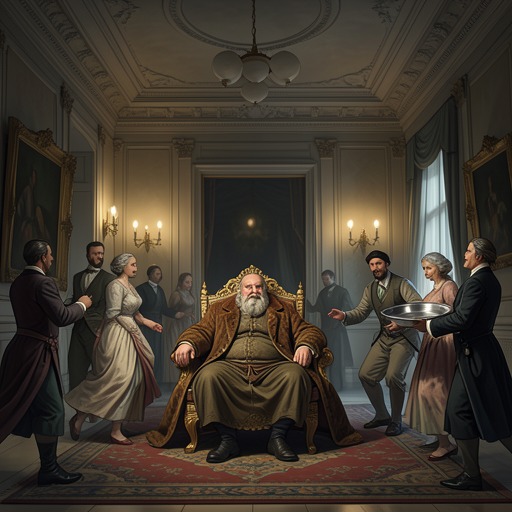
Great Men History View
War and PeaceGreat man theory is the historical model that treats rulers, commanders, and heroes as the principal causes of collective events. War and Peace presents it as the most tempting but most misleading way to understand history: prominent individuals give names and visible form to movements they do not originate, while the real force of war, revolution, retreat, resistance, and national survival lies in the combined activity of countless people and in laws that no single person fully understands.
Definition and Historical Appeal
The theory begins with an understandable human desire to find a clear cause for a vast event. When millions of people cross borders, fight, plunder, burn, and die, observers reach for the nearest intelligible explanation and attribute the movement to the will of the person standing in the most prominent position. Ancient historians explained national action through divine authority and chosen rulers; modern historians, after rejecting that theology in principle, often preserve the same structure by replacing divinely appointed heroes with monarchs, generals, politicians, journalists, and men of supposed genius.
The opening of the 1812 discussion makes this problem explicit. The French invasion of Russia began when the forces of Western Europe crossed the Russian frontier on June 12, 1812, after armies had been concentrating and moving eastward since 1811. Historians then assign the war to discrete explanations: the wrongs done to the Duke of Oldenburg, the failure to observe the Continental System, Napoleon Bonaparte’s ambition, Emperor Alexander I’s firmness, diplomatic mistakes, or an ill-worded memorandum. Each explanation reflects the standpoint of a particular participant. Napoleon Bonaparte could regard England’s intrigues as the cause; English parliamentarians could blame his ambition; the duke could blame violence against himself; merchants could blame the Continental System; generals could see the war as employment; and diplomats could identify a concealed alliance or an awkward document. The plurality of mutually interested explanations reveals the weakness of treating one visible motive as the cause of the whole movement.
The Individual as Label Rather Than Cause
The central proposition is that great men are labels attached to historical events. Napoleon Bonaparte may name an epoch, and Emperor Alexander I may name the Russian resistance to it, but the label has only a small connection with the event itself. Their acts appear voluntary to the actors, yet in the historical sense those acts are involuntary: each is related to the whole course of history and to conditions extending beyond personal intention.
The text illustrates this distinction through the image of a ripened apple. The apple falls amid a coincidence of conditions: its attraction to the earth, the withering of its stalk, the sun’s drying effect, its increasing weight, the wind, and the desire of a child beneath the tree. It is possible to isolate any one of these conditions and call it the cause, but none alone explains the event. In the same way, saying that Napoleon Bonaparte went to Moscow because he wished to, or that he perished because Emperor Alexander I desired his destruction, mistakes a participant’s intention for the total movement that made the outcome possible.
The same criticism applies to military judgment. The Battle of Borodino brought the Russian army nearer to the destruction of Moscow and the French army nearer to the destruction of its entire force, yet Napoleon Bonaparte offered battle and Mikhail Kutuzov accepted it. Before the battle, the Russian and French forces stood at roughly one hundred thousand against one hundred and twenty thousand; afterward, the balance was little more than fifty thousand against one hundred thousand. A later observer can make the decision appear irrational or can attribute it to a commander’s genius, but that retrospective clarity does not prove that either commander controlled the entire situation. The battle emerges instead from the accumulated pressures, movements, fears, and necessities within which both men acted.
Against Biography as Historical Explanation
War and Peace rejects the method by which historians explain the Revolution through the sayings and deeds of a few dozen people in Paris, then explain the Napoleonic period through a detailed biography of Napoleon Bonaparte and the people for or against him. Such an account reverses the relation between cause and effect. The sum of human wills produced the Revolution and Napoleon Bonaparte; that same sum first tolerated and later destroyed him. The existence of a conqueror wherever there is a war does not establish that the conqueror caused the war, just as the coincidence between a clock’s hands pointing to ten and a neighboring church’s bells ringing does not show that the clock caused the bells.
The text extends the argument through the locomotive metaphor. A locomotive’s wheels, whistle, smoke, and visible movement occur together, but none of these surface signs by itself explains the engine’s motion. The explanation must correspond in scale to the movement being explained. In the same way, the movement of peoples requires a force commensurate with the movement of peoples, not merely the personal will of a hero, an intellectual influence, or a secondary effect produced by several smaller forces. Histories that follow only Caesars, Alexanders, Luthers, Voltaires, Napoleon Bonaparte, or Emperor Alexander I cannot account for everyone who participates in an event and therefore cannot fully describe the movement of humanity.
Biographical historians also contradict one another when they explain the same figure. One historian may attribute Napoleon Bonaparte’s authority to virtue and genius, while another attributes it to trickery and deception. When historians of different nationalities assign the same event to Napoleon Bonaparte, Emperor Alexander I, or another person, their incompatible answers cancel the assumption that power inheres naturally in the hero. Universal historians move closer to the truth when they speak of many interacting forces, but they often continue to treat the resulting power of a historical personage as though it were itself the cause. The theory thus survives by shifting its vocabulary rather than solving the problem.
Mass Movement, War, and Consequence
The critique becomes most forceful when applied to collective violence. The French invasion of Russia involved millions of people and produced crimes on a scale that whole centuries of legal records could not match: frauds, treacheries, thefts, forgeries, false money, burglaries, incendiarisms, and murders. To attribute such a movement to a single commander’s ambition is to conceal the social conditions and individual actions that made it possible. Great-men explanations can make collective crimes appear authorized by monarchs, ministers, parliaments, newspapers, patriotism, political unity, the balance of power, or civilization, but justification after the fact is not the same as causation.
The evacuation and burning of Moscow demonstrates the same principle. Count Fyodor Rostopchin is often represented as the instigator of the destruction, while the French attributed the Fire of Moscow to his fierce patriotism and the Russians to French barbarity. The account rejects both attributions as sufficient. After the Battle of Borodino, the abandonment and burning of Moscow were presented as inevitable outcomes of the military and social situation. Wealthier residents left, abandoning houses and much property, while poorer residents remained and destroyed what was left. This collective response had already appeared in towns and villages beginning with Smolensk and did not depend on Count Fyodor Rostopchin’s broadsheets.
Once the French entered the deserted city, the army dispersed through Moscow as water spreads through dry ground. Soldiers occupied abandoned houses, selected better quarters, marked several buildings as their own, and fought other units over them. Officers who tried to control the soldiers were drawn into the same appropriation; generals chose carriages in Carriage Row, and remaining inhabitants invited commanders into their homes in hope of avoiding plunder. The resulting fires and looting cannot be reduced to one person’s intention. A wooden city, emptied of residents and filled with soldiers who smoked, made campfires from the Senate chairs, and cooked twice a day, was placed in conditions where fire was bound to spread. The destruction therefore exposes the inadequacy of a heroic explanation: the event arose from the interaction of material circumstances, military occupation, hunger, abandonment, and countless immediate acts.
The Russian response in 1812 further shifts attention from commanders to the people. Guerrilla warfare was carried out by scattered groups that attacked larger masses, withdrew before stronger forces, and struck again when opportunity appeared. It violated the conventional tactical rule that an attacker should concentrate forces to gain superiority at the decisive point, yet it was repeatedly successful in wars with a national character, including the Russian resistance in 1812. The effectiveness of this dispersed action cannot be credited to a single heroic plan. It reflects a broad popular movement that altered the meaning of war itself.
Continuity, Power, and the Limits of Will
The alternative to great man theory is not a denial that historical figures act, command, or matter. It is an insistence that their actions must be located within continuous movement. Human history is compared to motion studied through infinitely small units: because individual wills are arbitrary and innumerable, the historian must examine their tendencies and integrate them rather than isolate a king or commander as an independent origin. No event has a true beginning, because every event flows uninterruptedly from another; no single historical personage expresses the total sum of individual wills.
The image of a ship and the wave before it clarifies why commands seem causative. As a ship moves, a wave foams ahead of it. To those aboard, that wave is the most visible motion and may appear to anticipate or govern the ship’s course. Yet close observation shows that the wave is produced by the ship’s forward movement. Historical commands function similarly. Because an order appears immediately before an event, historians assume that the event depended on the order; but when the event is reconstructed moment by moment and the historical figure’s connection with the masses is restored, the order is seen as dependent on the event’s wider conditions. However many commands are issued, an event does not occur unless other causes and collective movements make it possible.
This framework also dismantles the paired concepts of chance and genius. If historians cannot explain why a particular event occurred in a particular way, they call it chance; if a force produces effects beyond ordinary agency, they call it genius. These words often name an incompleteness in understanding rather than a clearly existing power. The apparent genius of a ruler may be no more explanatory than a ram’s supposed genius when it is driven into a special enclosure, fattened on oats, and later killed: the sequence gains coherence only when viewed within a larger purpose and system rather than from the limited perspective of the individual animal.
Great man theory therefore remains useful as a record of how societies remember power, but it fails as a complete account of historical movement. It turns commanders into causes, commands into origins, and outcomes into evidence of foresight. War and Peace instead places Napoleon Bonaparte, Emperor Alexander I, Mikhail Kutuzov, Count Fyodor Rostopchin, and other prominent figures within the larger field of armies, civilians, merchants, peasants, soldiers, and countless individual decisions. History’s task is not to deny visible leaders, but to discover the laws governing the continuous interaction of all who take part. The decisive historical force is consequently not the isolated will of the great man, but the total movement of peoples through conditions no individual can command.